KinSource
Minnesota Tales
The St. Paul Globe, December 20, 1891, p. 17
HOLIDAY SWEETNESS.
Candy Making at This, the Sweet Season of the Year.
St. Paul's Contribution to the Candy Box for the Holi-Days.
The Caramel Girl and the Tender Marsh-mellow Maiden.
How Candy Is Made and How It Reaches the Public.
 Few people have any idea of the manufacture of confections. The dear
girls, the sweet little creatures who dote on these succulent things,
really have the least knowledge. They have a vague fancy that it is
an employment a ravir, but it isn't by any means. Indeed, every pound
of bonbons represents just so much hard labor, and the work is often
far from pleasant; and if it were half as hard to eat it as it is to
make it, there would be a less number of comfortable dentists in
St. Paul. Yet it is a good thing, perhaps, that so many tons of
candies are eaten, for it gives employment to a great many people,
and it gives fees to dentists and doctors.
Few people have any idea of the manufacture of confections. The dear
girls, the sweet little creatures who dote on these succulent things,
really have the least knowledge. They have a vague fancy that it is
an employment a ravir, but it isn't by any means. Indeed, every pound
of bonbons represents just so much hard labor, and the work is often
far from pleasant; and if it were half as hard to eat it as it is to
make it, there would be a less number of comfortable dentists in
St. Paul. Yet it is a good thing, perhaps, that so many tons of
candies are eaten, for it gives employment to a great many people,
and it gives fees to dentists and doctors.
There is nothing recondite about the manufacture, although the
skilled confectioner guards the modus operandi with jealous caution,
as though it were a profound secret. But it does require a great
deal of skill and experience to succeed. A little carelessness or
indifference would ruin a whole batch, and the profits of a week's
industry would be dissipated. Some confectioners are artists, but
more are inadvertently cruel satirists. The former build images
that are really a delight, while the latter produce crude imitations
that are so very ridiculous that they are humorous. But they all
please the eye of the juvenile, and they are all flavored to the
palate of the little ones.
The favorite sweet among the ladies is the chocolate cream. It is a
dream of delight, and its appearance might easily influence one to
believe it grew on some delicious vine in paradise, but it comes
from precisely the same source as do the less pretentious and
less delectable taffy products. And there is a silent but recognized
ethics respecting the proper sort of candy to eat, and polite girls
are seldom seen having bonbons now, although a couple of decades ago
bonbons were considered the proper thing. Gum drops have also been
relegated to the past. The varieties most in vogue in St. Paul are
chocolate creams, marshmallows, caramels. The confectioners also
dispose of a great deal of crystallized fruits, rose leaves,
buttercups, jujube paste and the more common sorts, such as lemon drops
and stick candy. But for Christmas uses the mixed candies are considered
the proper thing.
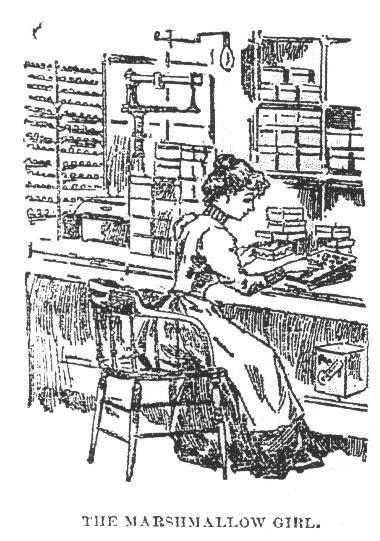 An hour watching the manipulations of the candymaker proves a very
interesting pastime. When this individual, who is as little known
to the public as the scene-shifter is at the theater, wants to make
chocolate creams, the first thing he does is to dip a kettle of
sugar from a barrel. Then he adds first enough water to keep it
from burning, and the kettle is placed over an intensely hot fire
in a furnace or range, as the case may be. He industriously stirs
the mass with a huge wooden ladle, until it begins to bubble and
boil cheerfully. Now the candy maker is all attention. He watches
every bubble with a scientific scrutiny. Suddenly he seizes
the big brass kettle and runs with it to a broad, cold slab of
gleaming marble. The mass is poured out upon this receptacle to
cool, but it has to be carefully watched. When it cools to just the
proper consistency - when it is soft as milk and firm as dough - he
catches up a bright metal shovel and goes to work. He mixes it, and
rolls it and kneads it until it is transformed into genuine candy,
with a fine grain and delicate.
An hour watching the manipulations of the candymaker proves a very
interesting pastime. When this individual, who is as little known
to the public as the scene-shifter is at the theater, wants to make
chocolate creams, the first thing he does is to dip a kettle of
sugar from a barrel. Then he adds first enough water to keep it
from burning, and the kettle is placed over an intensely hot fire
in a furnace or range, as the case may be. He industriously stirs
the mass with a huge wooden ladle, until it begins to bubble and
boil cheerfully. Now the candy maker is all attention. He watches
every bubble with a scientific scrutiny. Suddenly he seizes
the big brass kettle and runs with it to a broad, cold slab of
gleaming marble. The mass is poured out upon this receptacle to
cool, but it has to be carefully watched. When it cools to just the
proper consistency - when it is soft as milk and firm as dough - he
catches up a bright metal shovel and goes to work. He mixes it, and
rolls it and kneads it until it is transformed into genuine candy,
with a fine grain and delicate.
Meanwhile, an assistant has provided a number of oblong pans full of
the finest kind of starch. In this are dusted the shapes that are to
mould the creams. This is accomplished with a number of wooden tools.
The mass of candy is now taken from the shining marble slab and poured
into these pans through the medium of funnels. The creams are now
allowed to remain in these moulds until they are sufficiently hard to
be handled with impunity; then they are carefully removed and placed
in a new dish especially adapted to the purpose, and then turned over
to the care of a girl who is an adept. She has a jug of delicious
brown chocolate. With a silver fork with a single tine she dips the
creams in this chocolate, one by one, and they take on the delicate,
rich brown coating and the work is complete. But they are not yet ready
for the market. Like rare wine, they need age. Strange as it may seem,
nearly every sort of confections are like new bread - all the better
for being fresh-made. The chocolate creams, however, have to stand a
long time, some candy makers say the longer the better. They are placed
in a cold room, where they are stored until ripened.
 A candymaker's establishment resembles in some particulars an
apothecary store. There are numberless bottles and jars full of fruit
juices and extracts and coloring materials - some innocent, but a great
many are reputed hurtful. As a rule, these flavors are all made by the
candymaker himself. It requires a vast amount of experience to do this
and no end of caution in using the flavors. It is interesting to watch
him as he puts a few drops of lemon juice in this kettle of seething
sweetness and a little more of another sort in still another kettle,
and so on. The candymaker finds his occupation irksome, and the young
girls who assist him actually contract a dislike for sweetmeats.
After they have been employed in a manufactory a few months they
rarely eat any of the tempting delicacies that have tired their
eyes and destroyed their taste for them.
A candymaker's establishment resembles in some particulars an
apothecary store. There are numberless bottles and jars full of fruit
juices and extracts and coloring materials - some innocent, but a great
many are reputed hurtful. As a rule, these flavors are all made by the
candymaker himself. It requires a vast amount of experience to do this
and no end of caution in using the flavors. It is interesting to watch
him as he puts a few drops of lemon juice in this kettle of seething
sweetness and a little more of another sort in still another kettle,
and so on. The candymaker finds his occupation irksome, and the young
girls who assist him actually contract a dislike for sweetmeats.
After they have been employed in a manufactory a few months they
rarely eat any of the tempting delicacies that have tired their
eyes and destroyed their taste for them.
Copyright 2004 KinSource All Rights Reserved