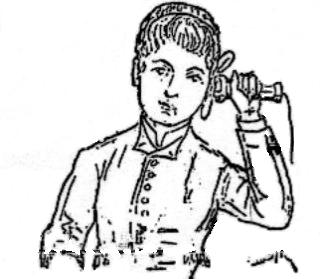
Although the question of priority of claim to the proprietorship of telephone patents was decided some time since in the supreme court of the United States, there are disaffected wiseacres who stoutly assert and
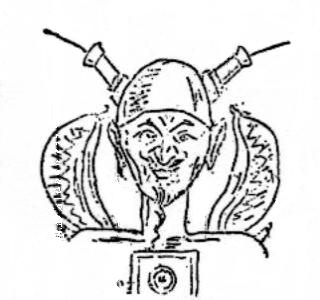
earnestly maintain that the real originator of the telephone was an individual called Old Nick, alias Old Harry, or the Old 'Un. Special attention is called to the fact that these positive people are invariably disaffected, for therein lies the key to
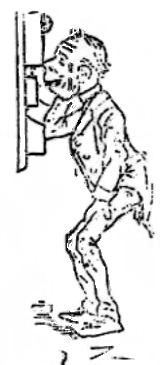 their conviction
in the matter. An extremely searching and careful investigation into the history and character of
the people who fondly cherish this belief has demonstrated in every instance that they belong to
either of the following classes typified.
their conviction
in the matter. An extremely searching and careful investigation into the history and character of
the people who fondly cherish this belief has demonstrated in every instance that they belong to
either of the following classes typified.
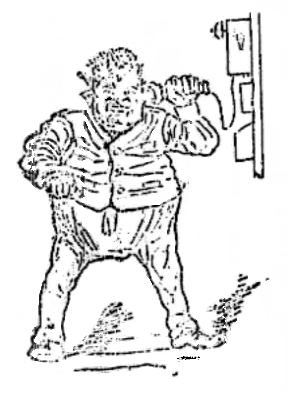
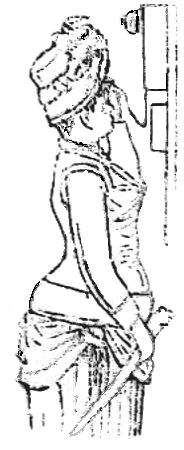
First, the testy, narrow-minded, hot-blooded male person of mature body, who never could appreciate the peculiarity of his detested friend. O'Grady, whose chief amusement during the busiest of busy business hours is to mystify him by telephonic inquiries concerning his fighting weight, digestions, etc. As our choleric friend is a little hard of hearing, and splutters when agitated, it follows very naturally that he is tormented by a fiendish corporation intrument and operator.
 For weeks, although they have
never met except in dreams, they have carried on a vague and romantic communion over the
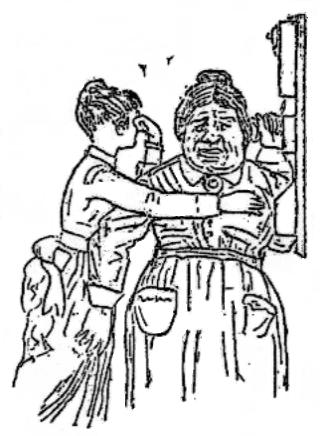
telephone. Finally, the Medusa, in shape of Anna's mother, catches on in great shape and
grabbing the instrument of affection from the hand of her daughter and draws
from the unsuspecting office clerk his name and address. Jenks has to write standing for some
weeks as the consequence of a visit from a brutal stranger, and both young people agree
that the instrument is possessed of a devil. Next we might consider the three cornered situation
of festive Mr. Backus, his wife and the young lady stenographer in his office. Under the plea of
catching up with his office correspondence, Mr. B. has passed several delightful evenings
enlivened by an occasional oyster supper. After one of these periods of absence from his home
and office he returns to the latter to find his telephone bell ringing furiously,
and to learn from an excited buzzing in the machine that his wife who has been calling him
for a full hour with the intelligence that Johnny has the croup.
For weeks, although they have
never met except in dreams, they have carried on a vague and romantic communion over the
telephone. Finally, the Medusa, in shape of Anna's mother, catches on in great shape and
grabbing the instrument of affection from the hand of her daughter and draws
from the unsuspecting office clerk his name and address. Jenks has to write standing for some
weeks as the consequence of a visit from a brutal stranger, and both young people agree
that the instrument is possessed of a devil. Next we might consider the three cornered situation
of festive Mr. Backus, his wife and the young lady stenographer in his office. Under the plea of
catching up with his office correspondence, Mr. B. has passed several delightful evenings
enlivened by an occasional oyster supper. After one of these periods of absence from his home
and office he returns to the latter to find his telephone bell ringing furiously,
and to learn from an excited buzzing in the machine that his wife who has been calling him
for a full hour with the intelligence that Johnny has the croup.
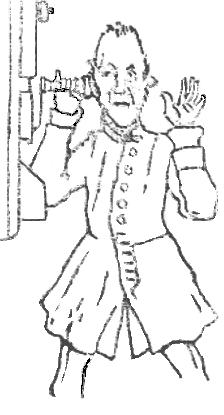 When the disastrous results of this denouement are appreciatively considered
it is easy to surmise what these three people think of the telephone. We have also to consider
the feelings of the bashful, ignorant gentleman, who, while shopping with his intended, is
requested by her to inquire by telephone for an article which she has mislaid at one of the
places visited. Having never used the telephone, and being easily broken up before an audience,
he retires after a five minute contest, red, perspiring and conscious of having been laughed at
by the young lady clerks. Ever after he cherishes malice against the infernal machine.
When the disastrous results of this denouement are appreciatively considered
it is easy to surmise what these three people think of the telephone. We have also to consider
the feelings of the bashful, ignorant gentleman, who, while shopping with his intended, is
requested by her to inquire by telephone for an article which she has mislaid at one of the
places visited. Having never used the telephone, and being easily broken up before an audience,
he retires after a five minute contest, red, perspiring and conscious of having been laughed at
by the young lady clerks. Ever after he cherishes malice against the infernal machine.
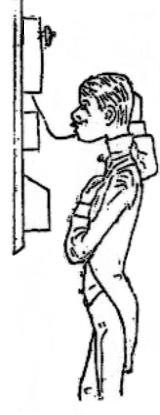 And how is it with the city editor of a daily newspaper. In the midst of harrassing supervision
of the work of his talented assistants, the telephone jangle alarms him several times a minute.
If he responds he is told that the counting room is wanted. If he does not respond he misses a
salacious, juicy item of information. Is he not justified in wishing that the man who invented
the telephone were dead? Ask the brave and energetic reporter, who, having finished his night's
work and consented to pleasurably anticipate a night's rest, what he thinks of the thing when he
is summoned at 3 a. m. to a fire or a necessary interview. Whether he answer or not, it is safe
to bet heavily upon his sentiment.
And how is it with the city editor of a daily newspaper. In the midst of harrassing supervision
of the work of his talented assistants, the telephone jangle alarms him several times a minute.
If he responds he is told that the counting room is wanted. If he does not respond he misses a
salacious, juicy item of information. Is he not justified in wishing that the man who invented
the telephone were dead? Ask the brave and energetic reporter, who, having finished his night's
work and consented to pleasurably anticipate a night's rest, what he thinks of the thing when he
is summoned at 3 a. m. to a fire or a necessary interview. Whether he answer or not, it is safe
to bet heavily upon his sentiment.
It might be well to refer to the case of the gentleman who tries to talk through the ear tube, and who cannot make himself [understood]. Or that of people who are continually wanting the First National bank or the state capitol, or other costly public or private buildings. From the number of demands made daily for the GLOBE, might be approximately estimated the number of people residing in St. Paul who "want the earth." There is no question, however, that the telephone is the most successful attempt by which prevaricating has been reduced to a system. A man may by its use pour the most extraordinary whoppers into his wife's ear without betraying one of the usual symptoms of a guilty conscience. The code of falsehoods used on occasions in which another girl and the theater are concerned has been stereotyped thus:
Husband --- "Halloo! Is that you, dear?"
Wife --- "Yes. What is it?"
Husband --- "Well, you needn't wait for me to-night. I've got a lot of important bills to attend to (theater bills). Shall be horribly busy. Don't you sit up."
Wife --- "Is that so? I'm really sorry, dear."
Husband --- "All right. Good-bye."
Wife --- "Halloo!"
Husband --- "Well, what's the matter now?" (looking at his watch).
Wife --- "Will you have much to do at the office, dear?"
Husband --- "Awfully busy."
Wife --- "Shant be able to get away from the office until late?"
Husband --- "That's what I said. Good-bye."
Wife --- "Halloo!"
Husband --- "What ails you? Can't you understand? I've got to get back to the office."
Wife --- "Where?"
Husband --- "At the office. Good-bye."
Wife --- "Wait a moment."
Husband --- "I can't wait. What do you want?"
Wife --- "I only want to say that I'll come down and wait for you. Then you will not have to come home alone in the dismal morning air -- all alone. Good-bye."
Husband --- "Halloo! halloo! Wait a moment. Are you there? All right. Don't come down. This is business. I may have to go up to the Merchants hotel to see some railroad men from Chicago. Good-bye."
Sometimes the wires get crossed and the wrong message goes to the right person. For instance, the same gentleman desires to talk to the same young lady who accompanied him to the theater on the previous occasion. The wires, by some peculiar diabolical system of compensation, become crossed, and he is in reality talking to his wife. This is the way they do it:
Husband --- "Is that you, my dear?"
Wife --- "Yes."
Husband --- "Are you alone?"
Wife (with a flash of triumph in her eye) --- "Yes. Just at this moment I am ready to go out."
Husband --- "Don't go. I'll be up at 6 o'clock. The old woman has got onto our racket the other night and is on her ear, and she has just sent word that she is going to her mother's to-night. It's clear spite. Do you catch on?"
Wife --- "Certainly I do. Where does she think we went the other night?"
Husband --- "Oh, she knows all about it. Somebody told her we were at the Grand opera."
Wife --- "That's so. You'd laugh if you knew who it was."
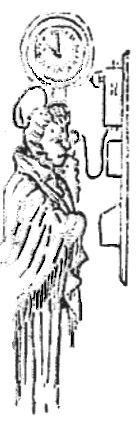
Husband --- "Oh, it was some blank fool."
Wife --- "Right you are, my dear. What do you propose?"
Husband --- "Meet me at the Brevoort at 7. Champagne dinner. Then we'll go to the Grand. I'll get a box and we'll fool her this time. If we get into a box we're all right."
Wife --- "Oh, yes, we're all right now. Make it 8 o'clock."
Husband --- "Good enough. Don't tail. Good-bye, darling."
Wife --- "Never fear, dear. I'll be there."
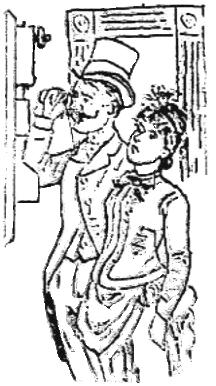
And we may be sure that she will be every time. Married men should always take the precaution to test the wires before making any break of this nature.
Seriously it may be stated that people who grumble at the shortcomings of the telephone would grumble still more were they to be deprived of its services. It is only the annoyances which are considered in place of the immensely overbalancing advantages. So self-apparent is this that it would be foolish to recapitulate or argue.
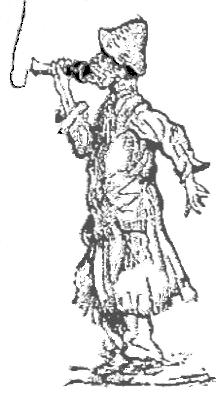
In this connection a few facts concerning the telephone service of St. Paul and Minneapolis may be of interest. In the former city are in operation 675 instruments, and in the latter 1,005, connected in the state of Minnesota with 1,800 miles of wire. The ordinary limit of effective conversation from St. Paul is something under one hundred miles; or say as far as Mankato, eighty-six miles distant. In the St. Paul exchange are employed in the day-time twelve young ladies, whose wages individually average $25 per month.