KinSource
Minnesota Tales
The Progress (Minneapolis), February 18, 1905, p. 4
WINTER STYLES.
Spring Millinery, Dress Materials, Checks, French Crepes and Skirts.
NEW YORK FASHIONS.
 HE fashionable hat brim having reached the utmost limit of absurdity, is now less aggressive -
not always in actual size, but is folded over twice or thrice, and even four times, as may suit
the individuality of the wearer, producing what milliners call "the envelope effects." As may be
easily imagined, pretty curves and undulations are the result, and now for the first time, the
broad-brimmed hat is generally becoming. Other styles have comparatively narrow brims, and taken
altogether the Spring hat will be of reasonable dimensions. Pointed toques and the medium sized turban
re-appear in great numbers, for the most part of satin finished mohair braid or white straw braid,
also in high lustre.
HE fashionable hat brim having reached the utmost limit of absurdity, is now less aggressive -
not always in actual size, but is folded over twice or thrice, and even four times, as may suit
the individuality of the wearer, producing what milliners call "the envelope effects." As may be
easily imagined, pretty curves and undulations are the result, and now for the first time, the
broad-brimmed hat is generally becoming. Other styles have comparatively narrow brims, and taken
altogether the Spring hat will be of reasonable dimensions. Pointed toques and the medium sized turban
re-appear in great numbers, for the most part of satin finished mohair braid or white straw braid,
also in high lustre.
Maline or Chiffon Folds
laid between the upright brim and crown of pointed toques, add their charm, and fall in with the all
pervading fancy for soft and graceful results. Many hats show the "envelope effect" exclusively at the
back, the sides folded over and meeting, which is an entire novelty. Considerable variety is noticeable
in crowns, some are flat, others high and even small pointed crowns are shown. The Continental, the
tri-Continental, and the Corday hat are all on view, the characteristics of the latter being its large
crown and overhanging brim.
Flower Hats
are prominent among early exhibits, made of small blossoms, and usually of moderate size. A new high
back hat is entirely of forget-me-nots, with a short rolling brim. A Corday hat has a crown of small
pointed rose leaves, the brim of maline shirring, with a cluster of pink roses on outer brim, and
seven pink roses form the bandeau, contrasting well with a facing of green maline. Violets in three
shades form a handsome toque, with a crown of lilac leaves, and a maline facing.
A crown of violets with a brim of lilacs is a stylish combination, or a brim of white forget-me-nots and
a leaf crown.
Two White Camelias
make a pretty showing at the left side of a turban, made of wood violets. A crimson hat of shaded leaves
and a large ribbon rose with a yellow centre as the sole garniture, is charming for a really young person.
The ready-to-wear hat shows no special individuality, coming in rather large round or pointed shapes, and
often a combination of weaves, finished by a jaunty wing, quill or cockade. Hats showing plaided effects
in gray colors, and of glistening mohair braid are very pretty, but a dangerous experiment for any but
young persons. It one may judge by the present, flowers of all kinds will be in overwhelming favor and
large roses or other kindred flowers are often in shaded tints. Green bids fair to be a prime favorite,
blue is always welcome and brown in varied hues is charming alone, or as an offset to brilliant colors.
In Dress Goods
and other departments as well, H. O'Neill & Co., give authoritative information as to what will be
fashionable. All varieties of mohair are in enormous demand prominent among which are the Tartan effects
in Panama weave, also in blue and green checks. The two-tone mohair, striped mohair, or the plain mohair
are equally fashionable and beyond a doubt there are the leading fabrics of the season. The preference
accorded last season to checks seems to have been but a beginning, so extensive is the present variety.
Shepherd checks in several sizes are also a leading style. Next in favor come Tweed suitings sufficiently
handsome and varied to rival any of the above mentioned materials.
Panne Chiffon Broadcloths
having a crepe finish are exquisite Spring fabrics, and afford a beautiful foundation for rich trimmings -
laces or passementeries. French crepes have been very largely worn for evening during the winter and will
make charming Spring dresses for street or house wear. The smooth finish of eoliennes is preferred by some
shoppers, and Henriettas, veilings or voiles, come in all Spring shades, and subdued colors as well.
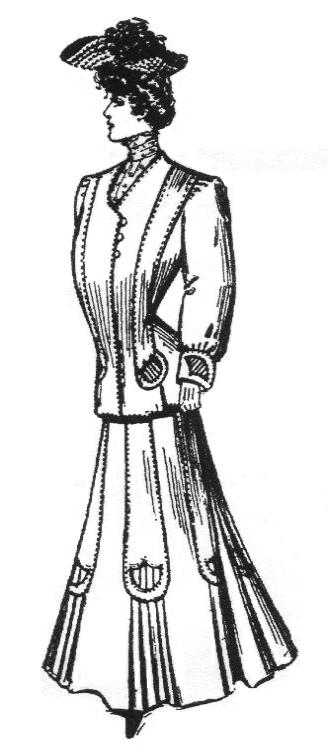
Illustration.
This pretty suit, the illustration of which is supplied by the Royal Pattern Co., of New York City, is of
linen, trimmed with shaped bands, and tucked pieces of material.
Skirts by slow degrees have been despoiled
of their super-abundant garniture, consequently, the up-to date skirt has a border trimming only, if any,
which is of course in harmony with that of the corsage, or coat and sleeves. Thus it may be inferred that
no special changes are anticipated regarding skirts, and plaitings will be as much in vogue as ever, with
of course the hip yoke effect. The sleeve is always a subject of vital interest, for is it not the keynote
of the gown or garment, with power to make or mar its distinction.
The basis of the Spring sleeve will be the leg o' mutton, that is, the sleeve must be full and bouffant at
top, and tight-fitting over the forearm, leaving the elbow the vantage ground for the display of the
dressmaker's genius for inventing variations.
Dress Trimmings.
Embroideries are developing into a tremendous "fad," and all kinds ever heard of are being used. Soutaches,
disposed in patterns and open-work, fancy braids employed as insertions; stitching in patterns, a new-old
idea; quantities of laces, appliques and motifs of heavy raised work, all are ready for the nimble fingers
of the dressmaker to manipulate into decorative schemes for Spring and Summer gowns of every variety of
material.
ROSALIND MAY.
Copyright 2005 KinSource All Rights Reserved